


The Strength Coach's Bookshelf: 10 Books Every Serious Coach Should Read


The Strength Coach's Bookshelf: 10 Books Every Serious Coach Should Read
One of the questions I get asked most often by newer coaches, aspiring coaches, and lifters who want to understand training at a deeper level is what they should read.
Sometimes the question is about strength training specifically. Sometimes it is about coaching in general. Sometimes it is from someone who has just completed a qualification and wants to continue learning, and sometimes it comes from somebody who has never sat in a classroom but has spent years under a barbell.
A while back I made a post discussing formal education, self-education, and practical experience. My position has always been that all three have value. Qualifications can provide structure, practical coaching develops judgement, and independent study allows you to explore ideas far beyond the limits of any syllabus. The coaches I respect most tend to be curious people who never stop learning, regardless of how many years they have been coaching.
The reality is that no list of books is ever completely objective. Every coach has influences. Every coach has authors they return to more often than others. Every coach has certain ideas that have shaped the way they think about training.
I am no different.
Anyone familiar with my work will know that I have a strong interest in Conjugate training, Soviet sports science, transfer of training, exercise selection, and the practical application of strength work to sporting performance. Those interests naturally influence what I read and what I recommend to others.
With that said, if somebody asked me to put together a list of ten books that every serious strength coach should make time for at some point in their career, this would be a very strong place to start.
That does not mean these are the only books worth reading. It does not mean every coach needs to agree with every author. It certainly does not mean that reading these books automatically makes somebody a good coach.
What these 10 books do provide is a foundation.
They expose you to many of the ideas that have shaped modern strength and conditioning, powerlifting, weightlifting, athletic development, and sports performance. They give context to methods that are often discussed without explanation. They help connect training decisions to broader principles. Most importantly, they encourage you to think critically about why training works rather than simply copying what somebody else is doing.
This is not the complete reading list I would recommend. There are plenty of other books that deserve a place on the shelf, and throughout this article I will mention additional resources that I think are worthwhile. I will also include some of my own books for readers who want to explore specific topics in greater detail.
For now, though, these are the ten books that I believe every strength coach should read.
(I'm not going to mess around with affiliate links or anything if you want help sourcing these books just message me and I'll sort it for you).
Fundamentals of Special Strength-Training in Sport - Yuri Verkhoshansky

Yuri Verkhoshansky was a Soviet sports scientist and coach whose work in the 1960s through the 1980s shaped much of the thinking on how to develop strength qualities specific to athletic demands. This book lays out the foundations of special strength training, moving beyond general strength development to examine how different forms of strength - such as explosive strength, speed-strength, and strength-speed - contribute to performance in sport.
The content focuses on the classification of exercises according to their transfer to competition movements, the mechanisms of muscular work and adaptation, and the organisation of training means to target specific physical qualities. Verkhoshansky emphasises the difference between general physical preparation and the more targeted special strength work needed for high-level results. It explores how to select and apply resistance exercises that enhance the power output and efficiency of sport-specific actions rather than building strength in isolation.
For weightlifting, the book provides a framework for understanding how assistance exercises and variations support technical mastery and maximal efforts in the snatch and clean and jerk. In powerlifting, its principles inform the selection of accessory movements that address weaknesses and improve the main lifts through better force production and targeted adaptation. Strongman coaches draw on its ideas around developing a wide range of strength qualities under varying conditions, helping athletes prepare for the diverse demands of events while maintaining transfer to competition performance.
It earns its place on the list because it gives coaches a clear way to think about exercise selection and training organisation beyond basic programming. The concepts encourage purposeful decisions that connect training choices directly to the athlete’s needs, making it a foundational text for anyone serious about bridging general strength work and sport-specific results.
Special Strength Training Manual for Coaches - Yuri Verkhoshansky & Natalia Verkhoshansky

This book serves as a practical guide developed from Yuri Verkhoshansky’s extensive research and coaching experience, with contributions from his daughter Natalia Verkhoshansky. It builds directly on the theoretical foundations laid out in Fundamentals of Special Strength-Training in Sport, translating concepts into actionable coaching methods. Where the earlier book establishes principles of exercise classification and special strength development, this manual provides coaches with clearer frameworks for programming and applying those ideas in real training environments.
The content covers the organisation of special strength training means, detailed exercise progressions, and methods for developing different strength qualities such as explosive power and speed-strength. It includes guidance on constructing training blocks, selecting appropriate loads, and monitoring adaptation, with an emphasis on how to make training more specific to the demands of competition.
In weightlifting, the manual supports the integration of assistance exercises that enhance technical efficiency and maximal strength in the competition lifts. Powerlifting coaches use its principles to design targeted accessory work that strengthens weak points and improves force application in the squat, bench press, and deadlift. For strongman, it offers valuable tools for building versatile strength capacities across varied events while ensuring those capacities transfer effectively to competition.
This title interweaves closely with Fundamentals of Special Strength-Training in Sport by moving from theory into application. It also connects strongly with Supertraining, which expands on many of the same concepts with broader scientific backing, and with Bondarchuk’s Transfer of Training in Sports, as both emphasise the careful selection of training means based on their degree of specificity and transfer. Together these books create a cohesive view of how to progress from general preparation to highly specific strength work.
It earns its place on the list because it equips coaches with usable structures rather than abstract ideas alone. The combination of father and daughter brings both foundational insight and updated practical clarity, helping coaches implement special strength principles across different sports and athlete levels
Supertraining - Mel Siff & Yuri Verkhoshansky

Supertraining stands as one of the most comprehensive resources on strength and conditioning theory. Mel Siff, a South African exercise scientist known for his rigorous analytical approach, collaborated with Yuri Verkhoshansky to produce this extensive work. First published in the late 1990s and later updated, it draws together decades of Soviet research with broader international findings to create a detailed examination of training principles and their practical application.
The book covers a wide range of topics including biomechanics, muscle physiology, adaptation processes, periodization models, special strength development, and the planning of long-term training. It explores how different training stimuli affect the body and provides frameworks for organising training to maximise performance while managing fatigue. The depth of information makes it a demanding but rewarding read that serves as a reference coaches return to repeatedly.
In weightlifting, Supertraining supplies a strong theoretical base for understanding how to develop the explosive power and technical proficiency required for the snatch and clean and jerk. Powerlifting coaches apply its insights when structuring accessory work, varying intensities, and addressing specific weaknesses in the squat, bench press, and deadlift. Strongman athletes benefit from its discussions on building versatile strength qualities and work capacity needed for diverse events while maintaining transfer to competition demands.
This title interweaves closely with Verkhoshansky’s other works. It expands on the concepts of special strength training introduced in Fundamentals of Special Strength-Training in Sport and the practical programming guidance found in the Special Strength Training Manual for Coaches. It also aligns with Zatsiorsky’s Science and Practice of Strength Training through its shared focus on adaptation and strength development, and with Bompa’s Periodization in its detailed treatment of training organisation over time.
It features on the list because it functions as a central hub that connects ideas across the collection. Coaches gain a deeper understanding of why certain methods work, which supports more confident decision-making across different training systems and athlete populations.
Periodization - Tudor O. Bompa & Carlo A. Buzzichelli

Bompa introduced his theory of periodisation in Romania in 1963. The work that became this book circulated first within Eastern Bloc coaching circles before reaching Western audiences, and its influence on how those countries approached athletic preparation was substantial. Eastern Bloc nations dominated international sport through the 1970s and 1980s following its adoption. The text has gone through six editions across several decades, with earlier iterations co-authored by Greg Haff before Buzzichelli, chosen by Bompa as his successor in the dissemination of periodisation, took over that role for the current edition. It has since been translated into 19 languages and used in over 180 countries. Bompa eventually settled at York University in Toronto as a professor emeritus and personally trained 11 Olympic medalists, including four gold medallists. Buzzichelli serves as international director of the Sport Division at the Tudor Bompa Institute and has delivered seminars at universities and sport institutes across Cuba, the Philippines, Brazil, and the United States.
The book is structured in three parts. Part I covers training theory, the basis and principles of training, preparation, and variables. Part II moves into planning and periodisation proper, covering the periodisation of biomotor abilities, session planning, training cycles, the annual plan, and peaking for competition. Part III addresses training methods, with dedicated chapters on strength and power development, endurance, and speed and agility.
Bompa describes two types of periodisation: that of the annual plan and that of biomotor abilities. The annual plan breaks down into phases, subphases, macrocycles, microcycles, and individual training units. The three phases are preparation, competition, and transition, and depending on how many competition phases fall within a year, the annual plan is labelled mono-cyclical, bi-cyclical, or tri-cyclical. Biomotor abilities, strength, speed, and endurance, can be integrated in a complex manner where all three are trained simultaneously across the year, or sequentially, where the year is divided into blocks with one quality as the focus per block.
For strength coaches working in powerlifting, strongman, or weightlifting, this is the structural architecture underneath everything else. Where the two Verkhoshansky texts deal in the Soviet model of special strength and the conjugate-sequencing approach to developing explosive capacity, Bompa provides the broader organisational framework: how to construct a year, how to move between preparation and competition phases, how to sequence the development of qualities over time. His six-phase model for strength development, anatomical adaptation, hypertrophy, maximum strength, conversion to specific strength, maintenance, and peaking, maps directly onto how a strength sport annual plan is actually built. The vocabulary most coaches are already using, macrocycle, microcycle, peaking, taper, came from Bompa. Reading this alongside the Verkhoshansky texts makes clear where the Soviet and Romanian traditions converged and where they diverged, particularly on the question of how much general preparation work a strength sport athlete actually needs and when to shift toward specific means.
Science and Practice of Strength Training - Vladimir M. Zatsiorsky & William J. Kraemer

The first edition appeared in 1995 under Zatsiorsky's name alone. It arrived in English having been shaped by decades of work inside the Soviet system. Zatsiorsky served for 26 years as a strength and conditioning consultant to Soviet Olympic teams, authored or co-authored 15 books and over 350 scientific papers, and held a chair in biomechanics at the Central Institute of Physical Culture in Moscow before eventually taking up a professorship in kinesiology at Penn State University. He also served for 20 years on the Medical Commission of the International Olympic Committee. The second edition brought in Kraemer, who contributed new chapters and integrated a North American research perspective. Kraemer himself had served on the Sports Medicine Committee for the United States Weightlifting Federation and on the Sport Science and Technology Committee for the United States Olympic Committee. The third edition added Andrew Fry of the University of Kansas and included new chapters on training velocity, overreaching and overtraining, and athlete monitoring.
The authors are explicit in the third edition's preface that the book carries the biases of their respective backgrounds: Zatsiorsky's experience was predominantly in the Soviet Union, East Germany, and Bulgaria, while Kraemer and Fry bring an American perspective. Rather than presenting a single unified system, the book treats that tension as part of its purpose.
The content covers training theory, the biomechanical and physiological bases of strength, and the practical construction of programmes. The classification of training methods is where this book has had the most lasting influence on strength sport coaching. Zatsiorsky describes the maximal effort method, which targets motor unit recruitment at near-maximal loads; the repeated effort method, which drives hypertrophy through accumulated fatigue; and the dynamic effort method, which targets rate of force development using submaximal loads moved at speed. Critically, he is clear that the dynamic effort method does not develop maximal strength and is useful specifically for improving explosive strength and rate of force development. That precision matters enormously in powerlifting and strongman contexts, where coaches frequently misapply these categories.
The book is built around the principle that there is no single programme that works for every athlete in every condition. The practical application of periodisation sits within that framework, covering the manipulation of volume, intensity, and density across training cycles, with attention to how loading strategies interact with individual response and long-term adaptation.
For strength coaches, this text occupies a different register from the Verkhoshansky and Bompa works on the list. Where Verkhoshansky is concerned with the logic of special strength development and the sequencing of concentrated loads, and Bompa provides the structural language of annual planning, Zatsiorsky and Kraemer go deeper into the biomechanical and physiological mechanisms that explain why loading strategies produce the adaptations they do. The taxonomy of training methods that runs through so much strength sport coaching, including the version popularised by Westside Barbell, which explicitly credits Zatsiorsky, originates here. Reading all three together allows a coach to move between the what, the when, and the why of strength programming with considerably more precision than any one of them provides alone.
The Training of the Weightlifter - R.A. Roman

R.A. Roman (sometimes billed as AA Roman) was a Soviet weightlifting coach and author whose work reflects the practical organisation of training systems used in elite weightlifting during the Soviet era. Published in the 1970s and later updated, this book presents a detailed manual focused on the full process of developing competitive weightlifters.
The content addresses technique development in the snatch and clean and jerk, strength building through specific assistance exercises, volume and intensity planning across different training phases, and the construction of yearly training cycles. It includes guidance on exercise selection, load management, and progression tailored to the demands of competitive weightlifting, with attention to balancing technical work and physical preparation.
In weightlifting, the book offers direct insight into how successful Soviet systems structured training around frequent practice of the competition lifts and their close variations. Powerlifting coaches draw from its approaches to intensity distribution and accessory exercise planning when preparing for maximal efforts in the squat, bench press, and deadlift. Strongman athletes benefit from its emphasis on building robust strength foundations and managing training loads across varied demands, supporting the development of both general capacities and event-specific skills.
This title interweaves with the other Verkhoshansky books and Supertraining through its practical application of special strength principles to a specific sport. It connects with Laputin and Oleshko’s Managing the Training of Weightlifters as another window into Soviet weightlifting organisation, and with Zatsiorsky’s Science and Practice of Strength Training in its treatment of adaptation and programming. Together they illustrate how theoretical concepts translate into structured training plans for high-level performance.
It earns its place on the list because it demonstrates how elite weightlifting systems apply core principles in a highly specific environment. Coaches gain concrete examples of long-term planning and exercise integration that inform their work across weightlifting, powerlifting, and strongman contexts.
Managing the Training of Weightlifters - N.P. Laputin & V.G. Oleshko

This is a short book. At 112 pages it is not a comprehensive manual in the way the Verkhoshansky texts or Bompa are, and that brevity is part of what makes it worth understanding clearly. It is a Soviet-era text, originally published in Kiev, devoted specifically to planning the training of Olympic weightlifters. The translation came through Andrew Charniga Jr. and Sportivny Press, the same channel responsible for bringing a number of key Soviet weightlifting texts into English, including works by Roman and Medvedyev. The book is both a review of relevant Soviet weightlifting research and a presentation of original research by Oleshko.
Much of what coaches encounter in this book they will already recognise by name, without necessarily knowing where it came from. The research of A.S. Prilepin, the former USSR national coach, is presented here, including the data on the optimal number of lifts per training session at given intensity percentages. At 70% of maximum, the optimal total is 18 lifts with sets of 3 to 6 repetitions. At 80%, 15 lifts with sets of 2 to 4. At 90%, 7 to 10 lifts with sets of 1 to 2 repetitions. This table has become one of the most reproduced and referenced pieces of data in strength sport programming, passed through powerlifting and strongman coaching largely via Louie Simmons, who Westside Barbell identifies as having first encountered Soviet training methods through this specific book. The data did not originate as a generic strength training guideline; it came from observational research on elite Soviet weightlifters and was intended to reflect what that population actually did in training.
The book also documents that highly qualified weightlifters perform approximately 20,000 lifts per year, of which 480 to 500 are performed at 90% of maximum or above in the classic and special exercises. This kind of accumulated load data, drawn from a classified system that categorised athletes from Class 3 through to Master of Sport International Class, gave coaches a structured basis for comparing training norms across ability levels. The Soviet classification system allowed training recommendations to be standardised and tested across populations in a way that had no equivalent in Western sport science at the time.
Topics covered include biomechanics of weightlifting technique, training methodology, sporting form, trainability, and recovery and nutrition. The concept of sporting form, meaning the athlete's readiness to compete at their highest level, receives specific attention, as does the question of how to achieve that state at the right time. The conjugate method is mentioned briefly in the text, treated as an already-understood concept requiring no detailed explanation.
For a strength coach, the significance of this book is not its length but its position in the lineage of ideas. It is the documented source for data that now circulates widely under Prilepin's name, often stripped of its original context. Read alongside the Verkhoshansky texts, it sits within the same Soviet research tradition but at a different level of specificity, dealing in observed training norms for elite lifters rather than theoretical frameworks for special strength development. Read alongside Bompa, it gives a concrete picture of what the periodised annual plans of competitive weightlifters actually contained in terms of volume and intensity distribution. For coaches working in weightlifting directly, it is source material. For coaches in powerlifting and strongman, it is the original context for tools they are almost certainly already using.
Facts and Fallacies of Fitness - Mel C. Siff
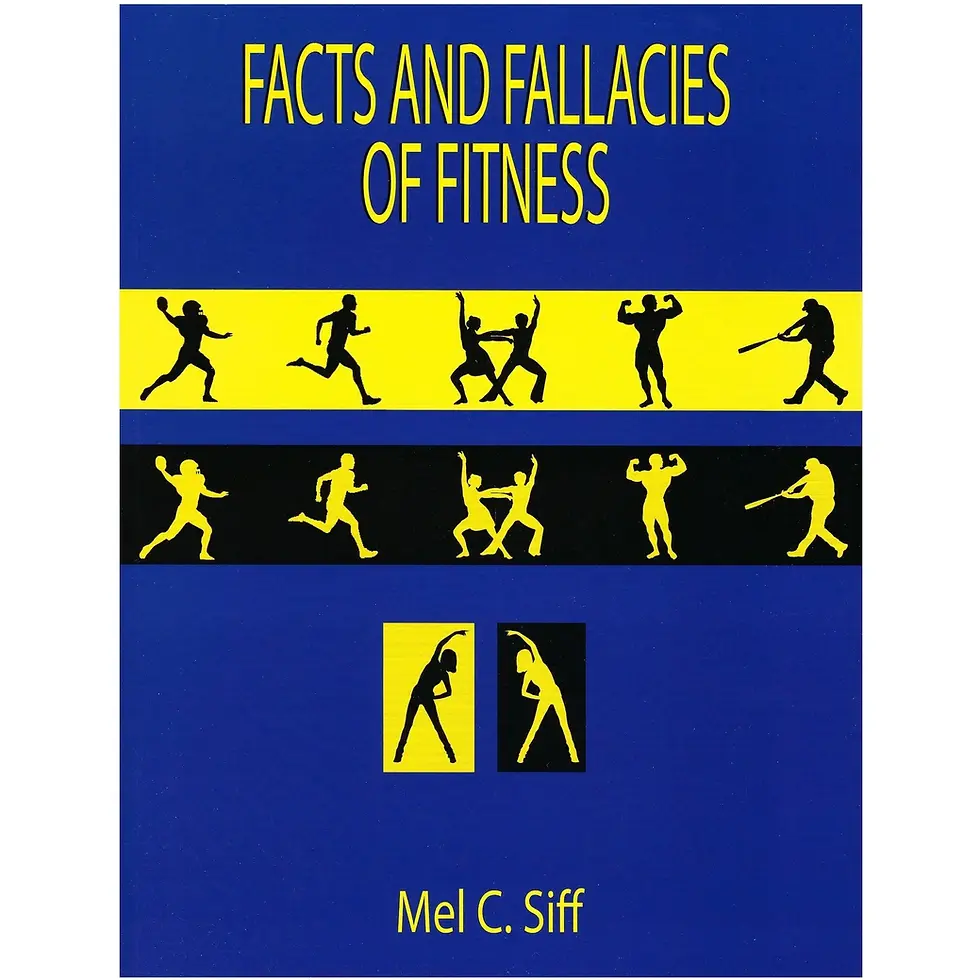
The same Mel Siff as Supertraining. This book, first published in the 1990s with later editions, takes a critical look at common practices and beliefs in the fitness and strength training world.
The content examines a wide range of training topics through the lens of science and practical reality. It addresses myths around exercise techniques, stretching, equipment choices, recovery methods, and popular training claims. Siff encourages readers to question assumptions and evaluate ideas based on biomechanics, physiology, and real-world outcomes rather than tradition or marketing. The tone is direct and educational, aimed at helping coaches and athletes develop better judgement.
In weightlifting, the book supports clearer thinking about technique refinement and assistance work by cutting through misconceptions that can hinder progress in the snatch and clean and jerk. Powerlifting coaches benefit from its discussions on exercise mechanics and load management when addressing the squat, bench press, and deadlift. Strongman athletes and coaches gain tools to assess event-specific training claims and focus on methods that genuinely build the broad capacities required for competition.
This title interweaves closely with Supertraining, as both come from Siff’s scientific perspective and share a commitment to understanding underlying mechanisms. It complements Zatsiorsky’s Science and Practice of Strength Training by reinforcing the importance of evidence-based decisions, and it pairs well with the Verkhoshansky works by promoting thoughtful application of special strength concepts instead of blind adoption of methods.
It cultivates the critical thinking needed to use all the other books effectively. In an area full of conflicting advice, Siff helps coaches separate useful principles from misleading information, leading to more reliable programming and better long-term results across weightlifting, powerlifting, and strongman.
The Westside Barbell Book of Methods - Louie Simmons
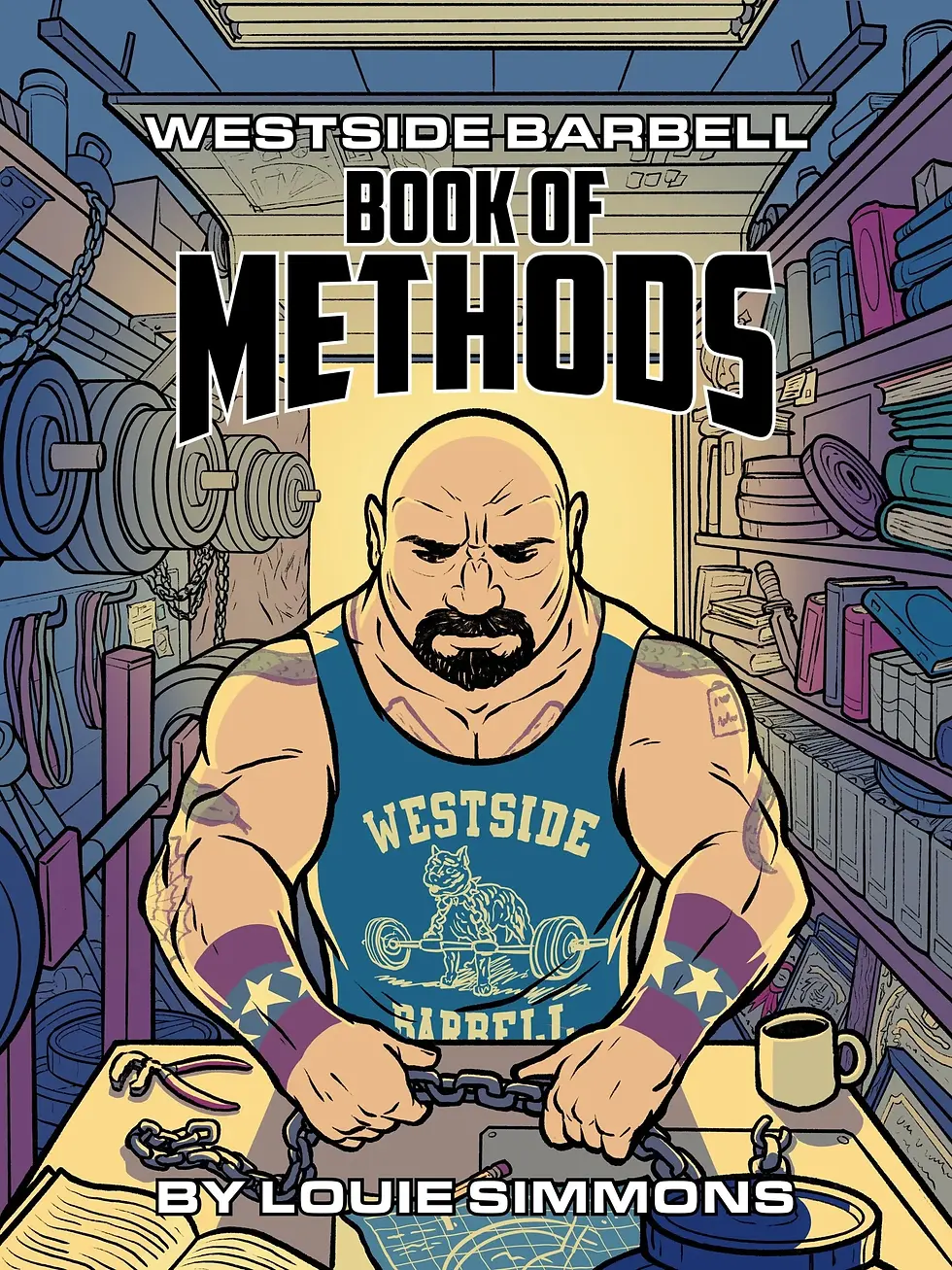
Louie Simmons built Westside Barbell into one of the most successful powerlifting gyms in the world through decades of continuous experimentation and coaching. This book serves as the foundational text for his training philosophy and the starting point for understanding conjugate training methods. Many coaches view it as the old testament of Louie’s work, the core reference that outlines the principles he spent a lifetime refining and applying.
The content details the conjugate system, including the use of max effort, dynamic effort, and repetition effort days, exercise rotation, accommodating resistance with bands and chains, and the selection of assistance movements to address individual weaknesses. It covers how to structure weekly training, manage intensity and volume, and continually adapt the programme based on the lifter’s needs and responses. The book emphasises problem-solving in the gym and building training systems that produce consistent long-term results rather than following rigid templates.
In powerlifting, it provides a complete framework for developing maximal strength in the squat, bench press, and deadlift through varied stimuli and targeted accessory work. Weightlifting coaches draw on its approaches to explosive strength development and exercise variation when preparing for the snatch and clean and jerk. Strongman athletes benefit from the methods for building work capacity, grip strength, and event-specific power, along with the system’s flexibility in handling diverse training demands.
This title continues in the tradition of the Soviet-influenced books on the list by applying similar principles of special strength development, exercise specificity, and adaptation in a Western powerlifting context. It connects particularly well with Verkhoshansky’s work on special strength and exercise classification, Zatsiorsky’s insights on strength training science, and Roman and Laputin’s emphasis on organised training cycles. The Book of Methods shows how these foundational ideas can be expressed through a constantly evolving conjugate approach.
I would argue it is one of the most important, because it translates theory into a living, practical system. I have written extensively on conjugate training and Louie’s methods in my own books, building directly on the foundations presented here. The Westside Barbell Book of Methods gives coaches a powerful model for solving problems, rotating exercises, and developing well-rounded strength that serves powerlifting, weightlifting, strongman, and other athletic populations.
Transfer of Training in Sports - Anatoliy P. Bondarchuk

Anatoliy Pavlovich Bondarchuk died in December 2025, aged 85. He had picked up the hammer throw at 24, won the 1969 European Championship and set the world record twice that same year, took gold at the 1972 Munich Olympics with an opening throw of 75.50 metres, and added bronze at the 1976 Montreal Games. He held a doctorate of pedagogical science from the University of Kiev and had been researching high-performance training methods throughout his competitive career. After retiring from competition he led the USSR National Team throws programme from 1976 to 1992. His athletes broke 12 world records and won all hammer throw medals across four consecutive non-boycotted Olympic Games. His most notable trainee was Yuri Sedykh, whose world record of 86.74 metres, set in 1986, still stands. After 1992 he coached for Portugal and Kuwait, then moved to Kamloops, British Columbia in 2005 where he continued working with throws athletes including Dylan Armstrong and Sultana Frizell, and consulted for Olympic and world hammer champion Ethan Katzberg. He wrote 11 books and approximately 195 articles across his career. Volume I of Transfer of Training in Sports was translated by Michael Yessis and published in 2007, representing over 20 years of accumulated research on exercise selection and its effect on athletic performance.
The central question of the book is straightforward and practically important: does this exercise actually improve performance in competition? Transfer, in Bondarchuk's usage, means the degree to which training work in a particular exercise produces observable improvement in the competitive event. The answer, he argues, depends both on the nature of the exercise and on the level of the athlete doing it, and these two factors interact in ways that most programme design does not account for.
The exercise classification system Bondarchuk presents is the book's most widely applied contribution. He identifies four categories: General Preparatory Exercises (GPE), which use energy systems and movements different from the competitive event; Special Preparatory Exercises (SPE), which use the same muscles and energy systems but in a different movement form; Special Developmental Exercises (SDE), which share both the musculature and component parts of the competitive movement; and Competitive Exercises (CE), which are identical or near-identical to competition. These categories sit along a continuum of specificity, and the book's argument is that the ratio and sequence of these categories across a training cycle must be adjusted according to the athlete's current level of mastery. Lower-level athletes benefit from a wider range of GPE and SPE work; highly qualified athletes require a much higher concentration of SDE and CE to continue progressing.
The second major contribution concerns how peaking is understood and managed. Bondarchuk presents a response-based model of peaking in which the athlete's individual data, collected session by session, determines when peak sporting form has been reached, and therefore when competition should occur. Peak form is not allocated by a calendar or a predetermined number of weeks; it is identified through observed performance trends for each individual athlete. The development cycle, maintenance cycle, and cleanse/rest cycle that structure his programming exist to bring athletes to that identifiable peak repeatedly across a year, rather than to fill a fixed block of time.
The book draws its examples primarily from track and field, particularly throws, and coaches outside those events will need to do some translation work. That translation is not difficult. The exercise classification framework applies directly to powerlifting, strongman, and weightlifting once the competitive exercises for each sport are defined. In powerlifting, the competitive squat, bench, and deadlift are the CE; exercises that share the same musculature and positional demands but differ in movement are SDE; the category into which a given assistance exercise falls should determine how it is programmed and how its effects on competition performance are monitored.
Within the reading list, this book occupies a particular position. The Verkhoshansky texts address special strength as a quality to be developed, and the sequencing of concentrated special strength work to drive performance adaptation. Bompa provides the structural language of annual planning. Zatsiorsky and Kraemer explain the physiological mechanisms behind different training methods. Laputin and Oleshko document what elite weightlifters actually did in training. Bondarchuk asks a different and more coach-specific question: given all of that, how do you know which exercises are actually moving the needle for this athlete right now, and how do you know when that athlete is ready to compete? That question sits underneath everything else in programme design, and this is the text that addresses it most directly.
With these ten books laid out, the full picture of the reading list starts to come into focus. At first glance, this list probably looks quite diverse.
You have books written by Soviet sports scientists, weightlifting coaches, powerlifting coaches, researchers, academics, and practitioners. Some focus on theory. Others focus on programming. Some spend hundreds of pages discussing physiology and adaptation, while others are built around practical coaching methods and training systems.
Spend enough time with them, however, and certain themes begin to emerge.
The first is that all of these authors are ultimately trying to answer the same question: how do we improve sporting performance through training?
That may sound obvious, but it is worth remembering because many modern training discussions become fixated on exercises, sets, reps, percentages, equipment, and programming templates. These books consistently pull the reader back towards the bigger picture. They are concerned with adaptation. They are concerned with performance. They are concerned with creating training systems that produce predictable long-term results.
This is one of the reasons the books remain relevant decades after many of them were first published.
The exercises change. The equipment changes. The technology changes.
BUT
The principles remain remarkably consistent.
Another theme running throughout this collection is the relationship between general and specific training.
Whether you are reading Verkhoshansky, Bondarchuk, Roman, Laputin, Zatsiorsky, or Simmons, you quickly encounter discussions surrounding exercise selection and transfer. Which exercises have the greatest impact on sporting performance? How much time should be spent building general physical qualities? When should training become increasingly specific to the demands of competition?
Different authors arrive at different answers, but they are all attempting to solve the same problem.
This becomes particularly interesting when viewed through the lens of powerlifting, weightlifting, and strongman.
Weightlifting has traditionally existed at the highly specific end of the spectrum. Success is determined by performance in two competition lifts. Technical mastery carries enormous importance. Training systems therefore tend to revolve around frequent exposure to the competitive movements and their close variations.
Powerlifting occupies a slightly different position. The competitive lifts remain central, but there is often greater room for variation, exercise rotation, and specialised assistance work. This is one of the reasons systems such as Westside Barbell and Conjugate training were able to develop so extensively within powerlifting environments.
Strongman presents another challenge altogether. Athletes must demonstrate maximal strength, explosive power, work capacity, movement skill, loading ability, overhead strength, grip endurance, and event-specific proficiency across a constantly changing collection of competitive tasks. The problem facing the strongman coach is rarely how to improve one lift. The challenge is how to develop a broad range of qualities simultaneously while still preparing for the specific demands of competition.
Despite these differences, many of the underlying principles discussed throughout these books apply equally well to all three sports.
Strength must be developed. Weaknesses must be identified and addressed. Training stress must be managed. Exercises must be selected according to their purpose. Adaptation must be evaluated over time rather than judged from individual sessions.
The further you progress through the literature, the more you realise that many apparent disagreements between coaching systems are often disagreements about application rather than fundamental principles.
A weightlifting coach may organise training differently from a powerlifting coach. A powerlifting coach may prioritise different qualities than a strongman coach. Yet all are attempting to manipulate the same biological processes and solve the same performance problems.
Perhaps the most valuable lesson contained within this collection is that no single book provides a complete coaching system.
Verkhoshansky helps explain special strength.
Bondarchuk provides a framework for understanding transfer.
Zatsiorsky offers insight into strength development and adaptation.
Roman and Laputin demonstrate how elite weightlifting systems were organised.
Bompa discusses training organisation and long-term planning.
Louie presents a practical coaching system built around many of the same principles viewed through a different lens.
Each author contributes a piece of the puzzle. Read together, they provide something much more valuable than a collection of isolated methods. They provide a way of thinking about training.
That, ultimately, is what separates a coach from somebody who simply follows programmes. Programmes answer today's questions. Principles help answer the questions that have not appeared yet.
One of the biggest mistakes coaches make when approaching books like these is assuming the value lies in the information itself. They read a chapter on periodisation and immediately start looking for ways to copy a periodisation model. They read about exercise classification and begin reorganising their exercise library. They read a chapter on dynamic effort training and start redesigning their entire programme around speed work.
What often gets missed is that the real value of these books is not found in individual methods. It is found in the way the authors think.
That distinction matters because most coaching problems are not solved by possessing more information. The average coach already has access to more information than any previous generation. Research papers, podcasts, seminars, social media, courses, mentorships, books, interviews, training logs, competition footage and case studies are available in quantities that would have been unimaginable thirty years ago. Information is rarely the limiting factor.
The challenge is learning how to organise that information into a system that allows better decisions to be made. That is where these books earn their place on the shelf.
Although the authors come from different backgrounds and often worked in different sports, they spend remarkably little time discussing individual exercises in isolation. Instead, they focus on the relationships between exercises, the relationship between training and performance, and the relationship between short-term decisions and long-term adaptation. They are concerned with how training fits together as a complete system.
For the coach working with powerlifters, strongman competitors, weightlifters, athletes, or even general population clients, this way of thinking has immediate practical value. Every programme is ultimately a collection of decisions. Why has this exercise been selected? Why is this volume being used? Why is this athlete training four days per week rather than three or five? Why has this variation been chosen instead of another? Why is one quality being prioritised while another receives less attention?
Many coaches can answer those questions by referring to what they have seen other coaches do. Fewer can answer them through a clear understanding of the principles involved.
The books on this list help close that gap.
They encourage coaches to think beyond templates and towards methodology. They encourage coaches to view programmes as expressions of broader principles rather than collections of sets and reps. They encourage coaches to understand the purpose of a training intervention before deciding whether it belongs in a programme.
This becomes particularly important as a coach gains experience. Early on, progress can often be achieved through competent execution of established systems. As responsibilities grow and athlete populations become more diverse, the ability to think independently becomes increasingly valuable. Two athletes can compete in the same sport, possess similar strength levels, and yet require completely different solutions to continue progressing. Situations like these are rarely solved by finding a new spreadsheet. They are solved by understanding the principles that sit underneath the spreadsheet.
That is why I believe every coach should spend time with books like these regardless of the population they work with. The goal is not to become a Soviet weightlifting coach, a Westside coach, a Bondarchuk coach, or a Bompa coach. The goal is to develop a deeper understanding of training itself. Once that understanding begins to develop, programming decisions become more logical, exercise selection becomes more purposeful, and coaching becomes less about following systems created by other people and more about applying principles to the athlete standing in front of you.
What Reading These Books Actually Looks Like
Reading this kind of material takes time and steady engagement. A newer coach might look at the full list and picture pushing through thousands of pages in a short stretch, but that approach misses how these books work best. They are dense with ideas built from years of practice and research, so they reward a measured pace rather than rapid consumption.
Most coaches find that the first pass through any of these titles gives a solid overview of the main concepts. Later readings reveal layers that were easy to overlook initially. The real depth often surfaces when you return to the pages after applying some of the ideas in the gym. Training decisions, athlete responses, and daily coaching choices create context that makes the written material connect more clearly.
Your relationship with certain authors tends to evolve as well. Early on, many people go to Verkhoshansky for his work on plyometrics and shock methods. With more experience, the greater value appears in his explanations of adaptation processes, how he classifies exercises, and the way he organises training around specific demands. The same pattern appears with Louie Simmons. Coaches often start by focusing on exercise rotations and accommodating resistance. Over time the more lasting insight becomes how he systematically identifies problems and builds solutions around the athlete in front of him.
This pattern repeats across the list. Each book offers immediate takeaways, yet the fuller picture develops gradually through repeated study and real-world use. The goal is not to finish every volume as quickly as possible. It is to build familiarity with the ideas so they start to influence how you see training situations.
Approaching the books this way sets up the individual sections that follow. Each review highlights core contributions while pointing out the parts that tend to reward ongoing attention.
Where These Books Agree More Than They Disagree
These books show far more alignment than division once you sit with them. Many coaches approach training literature as if it divides into opposing camps, yet the primary sources reveal consistent threads running through all of them.
Every author focuses on driving adaptation through structured training. They examine how to organise training loads over time. They analyse how to choose exercises that deliver the greatest carryover to performance. They address the need to balance stress with recovery. They consider how to bring an athlete to peak condition when it matters most.
These shared concerns form the core of the work. Differences surface mainly in the details of application, such as how to sequence phases, how much emphasis to place on certain qualities at specific times, or which tools fit particular environments. The underlying objectives remain steady across Soviet sports science, weightlifting systems, powerlifting methods, and broader strength and conditioning practices.
This perspective comes from years of drawing ideas from all these traditions and testing them with athletes. The literature does not split into separate worlds that compete against each other. Instead it offers complementary views on the same set of problems. Reading with this in mind helps you extract what serves your athletes rather than searching for one side to defend.
Where to Start and How These Books Fit Together
One of the questions that naturally follows a reading list like this is where to begin.
The honest answer is that there is no single correct route through the material. A powerlifting coach, a weightlifting coach, a strongman coach, and a university student studying sport science may all take slightly different paths and still arrive at a strong understanding of training.
That said, some books are considerably easier entry points than others.
A coach opening Supertraining as their very first strength training text is likely to have a very different experience than someone who has already spent time with Zatsiorsky, Bompa, Roman, and Verkhoshansky. The same applies to Bondarchuk. His work becomes far more useful once you already have a foundation in exercise selection, adaptation, and programme design.
For most coaches, a progression similar to the following makes sense.
Stage One: Building Your Foundations
Start with:
Starting Strength
Essentials of Strength Training and Conditioning
The Westside Barbell Book of Methods
These books provide an accessible introduction to the language of strength training, coaching, exercise selection, and programme organisation.
You do not need to agree with everything written in them. In fact, part of the value comes from identifying where your own views begin to diverge. What matters is developing familiarity with the concepts that continue to appear throughout the wider literature.
This is also where several of my own books fit particularly well.
The mini For Dummies series was written specifically to bridge the gap between basic understanding and more advanced material. The Conjugate Method for Dummies, The Squat for Dummies, The Log Press for Dummies, Commercial Gym Conjugate for Dummies, and Coaching Strength Athletes for Dummies are all designed to introduce concepts in a practical and accessible manner before readers move on to more complex texts. The Complete JHEPC Ebook Collection
Stage Two: Learning How Training Actually Works
Once the fundamentals are in place, the next step is understanding the mechanisms behind training.
This is where books such as:
Science and Practice of Strength Training
Periodization
Facts and Fallacies of Fitness
begin to shine.
At this stage the focus shifts away from simply knowing what coaches do and towards understanding why they do it. Concepts such as adaptation, fatigue, strength qualities, exercise classification, training organisation, and long-term planning start to form a coherent framework rather than a collection of isolated ideas.
Several of my books sit naturally alongside this stage.
Fix Your Weaknesses, The Art of Peaking, From Training to the Podium, How to Coach Yourself, and The Coach's Compendium are all attempts to translate coaching principles into practical decision-making frameworks. Rather than presenting isolated programmes, they focus on diagnosis, problem-solving, planning, peaking, and coaching logic.
Stage Three: The Soviet Deep Dive
Once you have a strong grasp of the basics, the Soviet literature becomes significantly easier to understand and apply.
This is where coaches should spend time with:
Fundamentals of Special Strength-Training in Sport
Special Strength Training Manual for Coaches
The Training of the Weightlifter
Managing the Training of Weightlifters
These books introduce a different way of viewing training. Exercise selection becomes more precise. Transfer becomes more important. Special strength development becomes a central concern. Coaches begin thinking less about exercises themselves and more about what qualities those exercises are developing.
This stage is where many coaches start to realise how much of modern strength training traces its roots back to ideas developed decades earlier.
Stage Four: Advanced Systems Thinking
Finally, there are the books that tend to reward coaches who already possess a substantial amount of practical experience.
This includes:
Transfer of Training in Sports
Supertraining
Block Periodization
repeated re-reading of many of the earlier texts
At this point the objective is no longer collecting information. It is refining judgement.
The questions become more specific.
Which exercises transfer best to this athlete?
How much variation is appropriate?
When is sporting form peaking?
Which qualities deserve priority right now?
How should the training system adapt to the athlete rather than forcing the athlete to adapt to the system?
These are the questions that occupy coaches for the rest of their careers. This is also where my larger system books were intended to sit.
The Complete JHEPC Conjugate System for Powerlifting, The Complete JHEPC Conjugate Strongman System, and the larger specialist texts are not introductory resources. They are attempts to bring together many of the principles discussed throughout this reading list and show how they can be organised into complete, long-term training systems for specific sports. They draw heavily from the work of Verkhoshansky, Bondarchuk, Zatsiorsky, Bompa, Roman, Simmons, and many others while adapting those ideas to modern powerlifting, strongman, and strength sport coaching.
Viewed this way, the books on this list are not separate recommendations competing with one another. They are part of an ongoing conversation about training that has been evolving for decades. Each author contributes a different perspective, a different solution, or a different way of viewing the same problem. The goal is not to pick a side. The goal is to build a broad enough understanding that you can draw from all of them when solving the problems presented by the athletes you coach.
These ten books offer a solid entry point into deeper thinking about strength training and athletic development. They connect ideas across decades of practice and research, showing how core principles hold steady even as methods evolve. Working through them at a steady pace, returning to key sections after time in the gym, and focusing on the underlying logic rather than isolated techniques helps turn the material into something practical.
The real measure of their value appears in how they shape your day-to-day decisions. When you select exercises, adjust training loads, or adapt plans for different athletes, the patterns from these texts start to guide you more naturally. You move away from simply replicating templates and toward building programmes that fit the person in front of you and the demands they face.
No reading list replaces time spent coaching, observing, and refining your own approach. These books support that process by giving you better questions to ask and stronger ways to evaluate what works. They reward coaches who treat them as ongoing references rather than one-time reads.
If you work through this collection and want to explore further, I have written several books that build on many of these same foundations while addressing specific areas in greater detail. They translate the principles into practical frameworks for conjugate-style training, exercise selection, and long-term athletic development.
The path to better coaching runs through consistent learning, thoughtful application, and a willingness to keep refining your understanding. These books provide excellent company for that journey.
5 Additional Reads from Other Perspectives
These five books bring complementary viewpoints that expand beyond the Soviet-heavy and Conjugate-focused foundations already covered. They draw from practical barbell coaching, modern block and agile periodization, applied physiology in team sports, and coach-athlete dynamics. Each adds distinct value without overlapping heavily with the main list.
Starting Strength: Basic Barbell Training – Mark Rippetoe
This book delivers a clear, mechanics-driven approach to the core barbell lifts. It emphasises teaching technique, managing progression for novices, and building a strong base through consistent execution. Many coaches return to it for its straightforward insights into how to instil fundamental movement patterns that support long-term development across populations.
Essentials of Strength Training and Conditioning – NSCA (edited by G. Gregory Haff and N. Travis Triplett)
Widely regarded as a core reference text, it covers the full scope of strength and conditioning with contributions from numerous experts. You get structured overviews of exercise physiology, program design, testing, and sport-specific applications. It serves as a reliable anchor for evidence-based practices and fills in gaps around team sport demands and facility-based programming.
Block Periodization: Breakthrough in Sport Training – Vladimir Issurin
Issurin presents a structured block approach that organises training into focused, cumulative phases. This method contrasts with more traditional linear models by prioritising concentrated stimuli and recovery. Coaches working with athletes who need targeted development of specific qualities often find it useful for planning medium- and long-term cycles.
Never Let Go: A Lifetime of Training and Coaching – Dan John
Dan John offers a grounded, experience-rich perspective on long-term athletic development, program simplicity, and focusing on what actually moves the needle. The book blends practical programming ideas with coaching philosophy, emphasising consistency, mastery of basics, and avoiding unnecessary complexity. It provides a refreshing counterbalance that stresses results over trends.
Conscious Coaching: The Art and Science of Building Buy-In – Brett Bartholomew
This title shifts focus to the relational side of coaching. It explores communication, motivation, and individualising approaches to different athlete personalities. The ideas help translate technical knowledge into effective implementation by building trust and addressing the human elements that influence adherence and results.
These recommendations round out a broader foundation. They pair well with the original list by adding Western barbell emphasis, textbook-level structure, contemporary periodisation models, veteran coaching wisdom, and coaching psychology. As with the others, read them actively and test the concepts in practice over time.
Why You Won't Find Triphasic Training on This List
One book some readers may be surprised not to see included is Triphasic Training by Cal Dietz.
The reason is not that I think it is a bad book. There are certainly useful ideas within it, and plenty of coaches have achieved good results using its methods. The reason it is absent is that I do not believe it contributes enough original concepts to justify a place ahead of the books already discussed.
The central premise of Triphasic training is that athletes should deliberately train the eccentric, isometric, and concentric portions of movement. That is a perfectly reasonable position. The difficulty is that none of those ideas originated with Triphasic training.
Long before the book was published, Soviet sports scientists such as Verkhoshansky and Matveyev had already written extensively on eccentric loading, isometric methods, shock training, explosive strength development, and the manipulation of muscular contraction characteristics. Louie Simmons incorporated many of the same concepts into the Westside system through tempo work, paused lifts, overcoming isometrics, yielding isometrics, dynamic effort training, and specialised exercise selection. Even Bondarchuk's work on exercise classification and transfer touches many of the same underlying questions from a different perspective.
What Triphasic training largely does is package these concepts into a structured block model built around emphasising one contraction type at a time.
Some coaches find that organisation useful.
Personally, I have never found it particularly compelling.
One of the recurring themes throughout the books on this list is that sport rarely presents isolated problems. Athletes need to express multiple qualities simultaneously. Strength, power, technical proficiency, work capacity, and resilience all interact. The challenge is not simply developing a quality. The challenge is developing the right qualities at the right time without allowing everything else to drift backwards.
This is where I believe more flexible systems tend to outperform rigid contraction-based phases.
A powerlifter may need maximal strength, rate of force development, technical practice, hypertrophy, and injury management all within the same training cycle. A strongman athlete may need to improve overhead strength, loading ability, grip endurance, conditioning, and event proficiency simultaneously. Separating training into neat eccentric, isometric, and concentric blocks often creates organisational problems that more adaptable systems avoid.
That does not mean Triphasic training cannot work.
Clearly it can.
It simply means that if your goal is to understand the origins of these ideas, the principles behind them, and how they fit into the broader history of strength training, I would rather point coaches towards Verkhoshansky, Zatsiorsky, Bondarchuk, Bompa, Roman, and Simmons. Those authors provide the foundations upon which many later systems, including Triphasic training, were built.
For that reason, I view Triphasic Training as a useful interpretation of existing concepts rather than a foundational text in its own right.

$50
Product Title
Product Details goes here with the simple product description and more information can be seen by clicking the see more button. Product Details goes here with the simple product description and more information can be seen by clicking the see more button

$50
Product Title
Product Details goes here with the simple product description and more information can be seen by clicking the see more button. Product Details goes here with the simple product description and more information can be seen by clicking the see more button.
$50
Product Title
Product Details goes here with the simple product description and more information can be seen by clicking the see more button. Product Details goes here with the simple product description and more information can be seen by clicking the see more button.

Comments