


Training Without A Crew: A Solo Lifter’s Guide to Equipped Powerlifting

Updated: Mar 2
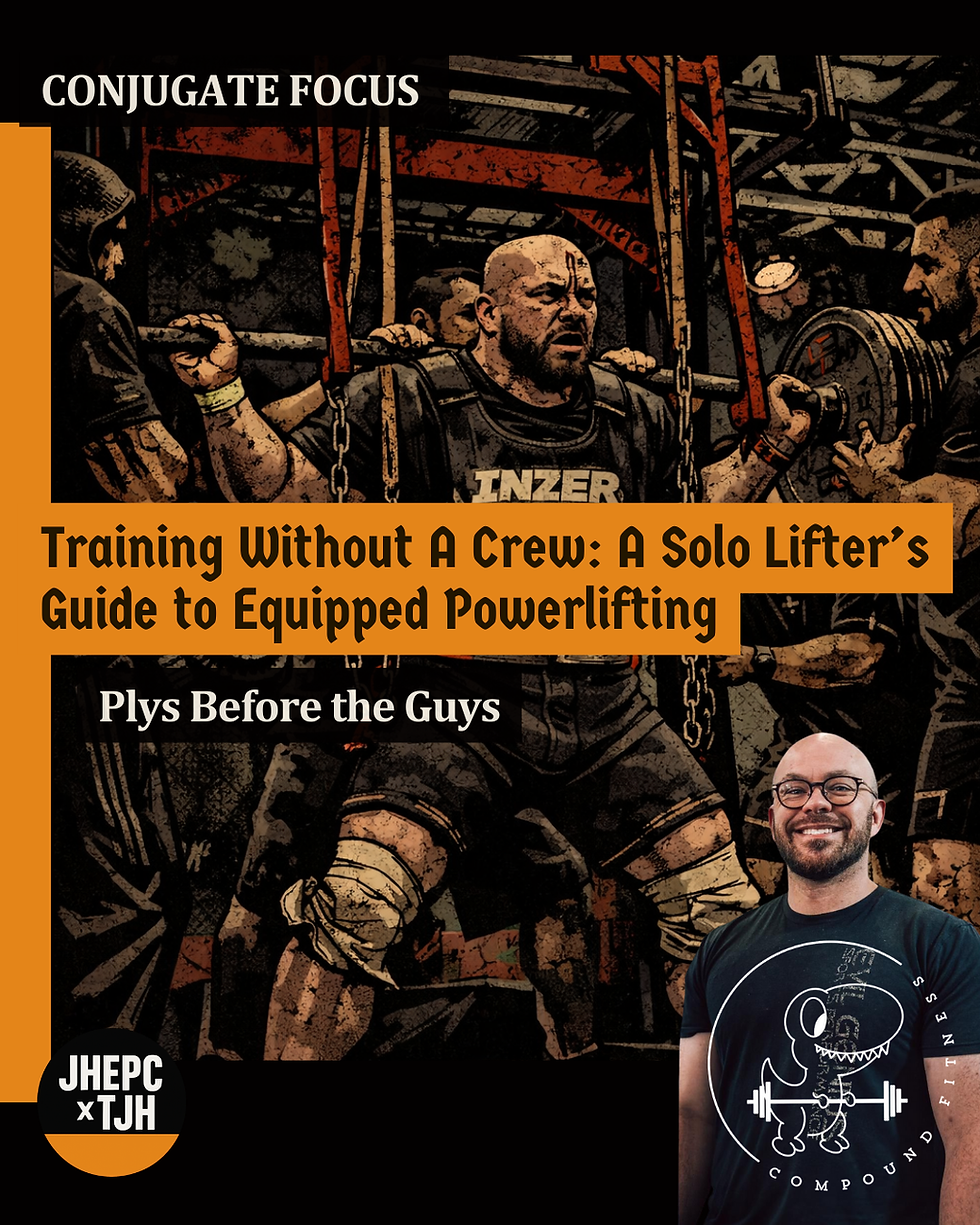
Training Without A Crew: A Solo Lifter’s Guide to Equipped Powerlifting
Plys before the guys
Powerlifting can be a solitary sport, training alone for hours each week in a gym, sometimes only having others assist you when you need a spot or a handout. That is a rarity within equipped powerlifting. Equipped lifters are like those teenagers you see on a Monday huddled around a bench for two hours, except with a lot more plates and plys.
So what if you want to give equipped powerlifting a try, but you’re a solitary animal within a gym that doesn’t house any other equipped lifters or barely any raw powerlifters? You don’t want to be starting a prep for a competition, or just dipping your toe in to equipped and be unable to train just because others couldn’t make it into the gym, or be needing to travel 90 minutes each way four times a week in order to train with other lifters.
First thing first, make sure you can dress yourself.
Sounds like a silly point, but for the uninitiated having other people help you in and out of equipment is commonplace. Whether that be helping pull briefs up, putting suit straps on or squeezing you into a bench shirt, it is much easier to do with help. However if you want to be self-sufficient for the most part, you need to be a bit more forgiving with your equipment sizing.
It isn’t the end of the world to train solo with tight briefs, squat or deadlift suits. You can always hang like you’re taking a ride in an adult baby bouncer from a barbell using the straps to squeeze yourself in, or add loops to the briefs and use strapping wrapped around the bar. Then hang in reverse to take them off. Just never leave plates on the floor once you’re in the kit or you’ll find yourself joining them.
The bench shirt is a different animal, in particular with single ply compared to the less restricting multi ply and the total freedom of unlimited. If you manage to cram yourself into a tight shirt by yourself, but lose the ability to use your arms once in it, you’re asking for difficulties if you’re training on your own. Quite often lifters may have multiple of the same bench shirt in different sizes to account for this. A larger shirt for when training on their own, alongside a tighter ‘competition fit’ for when they’re able to train with others and on competition day. Both shirts will need to be broken in and learnt though, so make sure you take your time with both.
Larger equipment will also mean less pressure which will impact safety, which leads on to my next point.
Safety and load management go hand in hand.
If you're going to be training on your own you need to consider exercise set up, safety and load for all of your sessions. Safeties on the bench/combo, or the straps/chains on the mono lift, need to be set to the correct height. That doesn’t mean ‘oh that’ll do’, it means ‘if this squat folds me or I throw a bar at my face/stomach will I be safe’.
Load selection goes a long way here too, especially if you don’t have anyone to run a mono lift, are walking out of a combo rack/cage or self handing out a bench. Train submaximally prioritising safety until you are able to get sessions in with training partners/crew when necessary or in the run into a comp.
If you don’t have access to a mono lift, mastering the squat walk out and maintaining tightness throughout will be an incredibly valuable skill. Especially if you find your equipment to be restrictive or you don’t train using a squat bar. You don’t want the weight bouncing around or oscillating as you try to steady yourself pre set, and combining that with the pressure of kit can be a recipe for disaster. So learn and perfect your walk out raw before transferring it over. Be slow and deliberate.
As for the bench handout, self handing out in bench shirts isn’t anything close to ideal, but still not impossible and is workable. If you train at a gym that has self releasing weight hooks they can be a fantastic option here, line up under the bar with it at the top of your line and simply pop it up. The hooks will retreat out of the way for you to complete your set before you return it backwards into them. But be careful of setting them too high for an easier self handout, then being unable to rack the bar again afterwards.
Self handing out from a traditional rack in a bench shirt is where it can become tricky. Really work on becoming efficient with the drag of the unrack before getting into a shirt. Wrap a light band around the back of the hooks and over the ends of the bar to just practice bringing it out into position and experiencing the lat tightness and hand pressure needed. This will also feed into increased performance for the press itself, so it’s a win win. An improved unrack can improve any bench so it’s worth learning regardless! (I’ve recently just filmed this drill for a client so let me know and I can share it with you). Again, hook set up there is paramount. We don’t want to be receiving the bar with bent arms, so it needs to be high enough that once you’ve set your lats it just pops over the hooks and pulls into position, yet also at a height you can go straight back into the hooks at the end of the set.
When it comes to setting your shirt it is much easier to do solo in unlimited or multi ply, but perfectly possible in single ply too. During a self handout the shirt can drift up towards your neck, so account for this by almost over setting the shirt. A belt can also be used to lock the shirt into position, but it’s worth bearing in mind how much that can affect the difficulty of getting a touch and holding a line, purely through the fabric being more stretched over the chest plate.
But the number 1 rule is…
TEST YOUR SET UP AND SAFETIES ON FILM SO YOU CAN REVIEW IT, BEFORE PUTTING ANY EQUIPMENT ON.
Powerlifters as we know love to film a lot of their sets and reps and with equipped lifting it is going to be paramount. Research what the risks are in that specific kit and how lifts can go wrong, then watch for any tells on a set by set basis. This enables you to adjust load and set up where required. You might not be able to move as much weight, but you’re still getting more work in than you would be if you relegated being in equipment to only when you have a team around you.
YOU WILL FAIL, THAT IS OK. LEARN TO FAIL SAFELY.
You can take a hybrid approach into your equipped training. Train fully solo in the majority of your sessions going into a competition. Then if you can, get competition lifts done with people around you ensuring you’re hitting comp standards, which will enable you to push those lifts/variations further. This will pay dividends on the big day.
Once you approach the final 4/6 weeks a prep it might be time to find some like minded equipped people or lifters you trust to keep you safe. You want people who will be honest with you about depth/lockout, and ideally spend at least one session a week alongside them. Even if you can go to a gym with people around you once a month to hit an ME variation or a competition lift with the same support you’d receive on a competition day, the confidence boost from that and the extra weight on the bar can set you up perfectly for the comp.
One of the biggest factors will be the mental game. Training equipped isn’t easy, training it solo is certainly not! You need to take the time to build confidence in the equipment whilst lifting on your own. Not to mention that you have to learn everything about your equipment and set up intimately, rather than relying on others for help. But this confidence and mental resilience will benefit you and others down the line tenfold if you do end up training with a crew. It will give you a deeper insight into the lifts, their requirements and limitations.
The reality is, it’s going to be rubbish until you hit your stride and find the set ups/methods that enable you to do this. Self handouts even with self releasing hooks will never be as good as a competent three man hand out. Max effort work is riskier, progression may be slower overall and if you don’t prepare for competition day by doing some lifts with others it can be quite jarring once you’re on the platform and now have the option of help.
Convincing yourself you need a crew to be an equipped lifter is gatekeeping yourself from the nichest aspect of an already niche sport.
Yes, it’s optimal with a crew, but optimal is the enemy of consistent. Better to train solo four times a week than wait for the perfect crew set up that never comes. The goal is to get on the platform and have some fun shifting some tin, solo training makes that possible.

Craig Cassie is a strength coach with over 17 years of coaching experience across rugby, strongman, and powerlifting. A former Team Josh Hezza athlete turned JHEPC coach, he’s known for his sharp technical eye, fast communication, and terrible sense of humour. Craig specialises in building strength, fitness, and resilience through a Conjugate-inspired approach that prioritises both performance and long-term health.

$50
Product Title
Product Details goes here with the simple product description and more information can be seen by clicking the see more button. Product Details goes here with the simple product description and more information can be seen by clicking the see more button

$50
Product Title
Product Details goes here with the simple product description and more information can be seen by clicking the see more button. Product Details goes here with the simple product description and more information can be seen by clicking the see more button.
$50
Product Title
Product Details goes here with the simple product description and more information can be seen by clicking the see more button. Product Details goes here with the simple product description and more information can be seen by clicking the see more button.


Comments